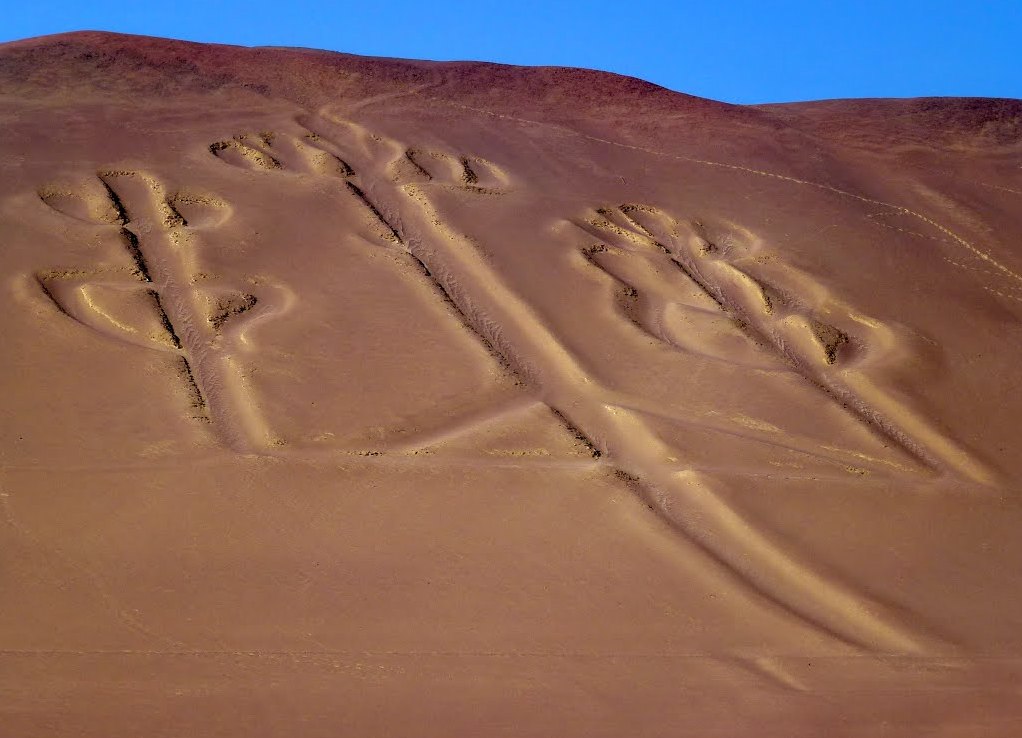
- Address: Pisco Province, Peru
- Founding date: 200 BC.
- Height: 128 m
- Width: 74 m
Peru is not only a country where, according to scientists, the first intelligent civilization developed, it is an amazing, mysterious and even mysterious state that has preserved many mysterious objects, the origin of which for centuries has been disputed by scientists, researchers and historians with whole world. One of these mysteries is the Andean candelabra.
Description
The Andean candelabrum in Peru , also called the Candelabra of Parakas, is a huge geoglyph on a sandy mountain in the bay of the Paracas Peninsula near the small town of Pisco. The length of the geoglyph is 128 meters, the width is 100 meters, the thickness of the lines is from 0.5 to 4 meters, and the depth in some places reaches 2 meters. The picture of the Andean chandelier, indeed, resembles a candlestick, hence the name of the site.
The Andean chandelier, like the world-famous Machu Picchu , is the center of discussions, disputes and research in Peru. Thanks to the results of one of these works, an approximate date for the formation of sights was established - the Andes chandelier is dated to 200 years BC. It is also surprising that for all the time of its existence the landmark was not destroyed either by frequent sandstorms, sea winds, people searching for treasures at the slopes of the mountain or arranging motocrosses near the object. For the sake of experiment, even such drawings were applied to neighboring slopes, but they disappeared within a few days - the unique phenomenon of Andean chandelier.
Theories and legends of the Andean chandelier
To date, there are many theories and legends about the origin of the Andean chandelier, but none of them has been proven or confirmed by any facts. Thus, the conquistadors linked the three branches in the figure of the candelabra with the Holy Trinity and believed that it was a good sign for the further conquest of the country and the conversion of local residents to Christianity. Sailors believed that the candelabra was created as a landmark, because its design is visible far from the shore. Some believe that the picture of the candelabra resembles the hallucinogenic grass of Durman, others argue that in ancient times the Andean chandelier served as a seismograph. In any case, none of the hypotheses found evidence, most likely, the true purpose of the Andean chandelier in Peru was lost in history.
How to get there?
If you want to see the Andean chandelier in all its glory, then it is better to do this from the sea, for this you need to go on a boat from El Chaco to the islands of Balestas , or from Pisco to sail by boat for about 20 minutes.
| | |